
Problem
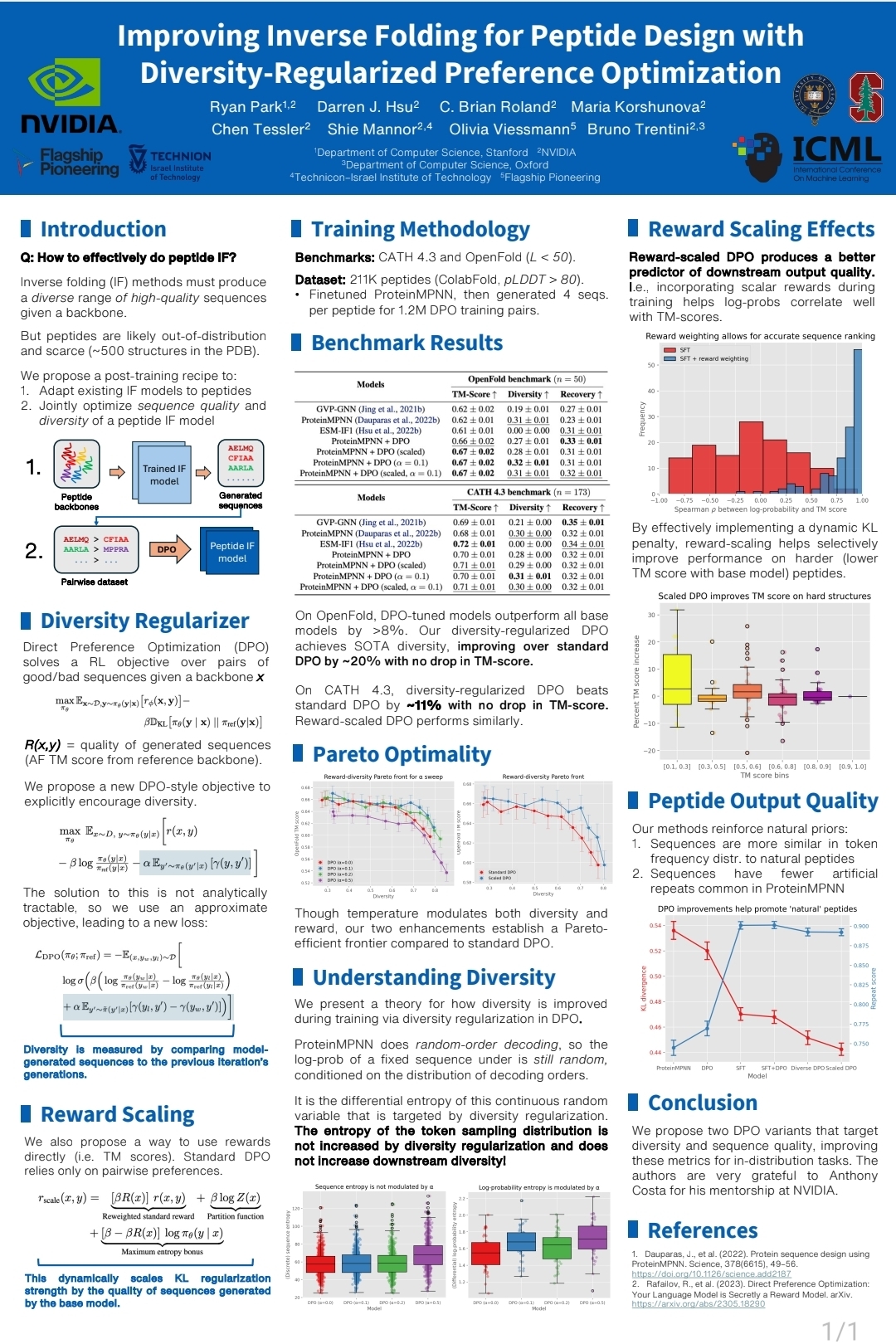
Inverse-folding systems can generate sequences compatible with a target backbone while concentrating on a narrow part of sequence space. For peptide design, increasing diversity is useful only if the generated sequences retain the required structural similarity.
Method
The team fine-tuned ProteinMPNN and applied direct preference optimisation with an explicit diversity regulariser. Evaluation paired sequence-diversity measures with structure-based checks so that improvement in one objective was not reported without the other.
My role
As Global Life Sciences Research Alliances Lead, I managed the eight-person science and engineering team. I coordinated the work on model fine-tuning, preference optimisation and evaluation through to publication.
Collaborators
The paper was authored by Ryan Park, Darren J. Hsu, C. Brian Roland, Maria Korshunova, Chen Tessler, Shie Mannor, Olivia Viessmann and Bruno Trentini.
Result
The reported method improved sequence diversity by 20% while maintaining structural similarity. The work was selected as a spotlight at the ICML 2025 2nd Workshop on Generative AI and Biology.