
Castes in the Age of AI
The Mastery of Technique and the New Public Square
The workshop
Artificial intelligence has ceased to be a laboratory curiosity and has become productive infrastructure. It has entered the working day much as spreadsheets, search engines, and automation once did, with one decisive difference: the gain is not merely convenience, but scale. The change is first felt in the bookkeeping of time. Costs fall, risks change their address, decisions quicken, and some outputs begin to exist in quantities that would once have been absurd. What arrives is not a solitary “machine” but a method: portions of practical reasoning are translated into routines that can be multiplied, audited, and reused. When that translation succeeds, productivity changes first at the level of minutes and margins, and only afterwards at the level of markets and macroeconomics [1, 2].
That is why the impact on labour appears first as a reduction of friction in the ordinary round. AI writes, revises, answers customers, helps to build systems, suggests decision-paths, and orders information. These verbs look humble, yet they name the everyday scaffolding of modern work. In practice, generative assistants have already produced measurable productivity gains in service tasks [3]. The explanation is plain. Much that wore the costume of “intellect” was, in fact, repeatable; and the time once spent upon it has become margin. Once margins appear, organisations begin to treat them as something to be harvested.
Estimates of substitution differ, but the direction of travel is consistent. Routine cognitive tasks are more exposed, particularly in office occupations [4]. Often what occurs is not a dramatic dismissal but a thinning-out of the post: fewer hires, sharper requirements, wage compression, and a premium for those who can integrate systems, verify results, and decide what is worth doing. The labour market, in other words, shifts its admiration: away from the merely competent performer, and towards the person who can supervise the tools, judge their output, and take responsibility for the decision that follows.
The mastery of technique
At this point the difference between using AI and mastering AI becomes clearer, and it is best stated by returning to the older idea of technique (tékhne). In Aristotle, tékhne is know-how with logos: productive knowledge that can give an account of itself in reasons [5, 6]. It is not blind repetition, but an understanding of means, ends, and, to a degree, the causes of what is produced. This matters because, socially, mastery of technique is mastery of the reproducible. What can be done reliably can be repeated; what can be repeated reliably can be scaled; and what can be scaled reliably begins, almost inevitably, to organise the rest.
This holds for competent users of AI, and more strongly for those who control its production. There is a world of difference between asking a system for help and owning the conditions under which help is possible. The former is a kind of literacy; the latter is a kind of sovereignty.
A correction is necessary, lest the picture become sentimental. Traditional capital may lose some of its relative force, but capital rooted in infrastructure — and in technological sovereignty — gains. Skill and distribution channels remain relevant, yet the strategic centre of gravity shifts towards energy, chips, data centres, networks, and the capacity to train and serve models at scale. Whoever controls infrastructure collects a toll without announcing it. Once this is seen, the cumulative advantage of major powers — governments and technology firms alike — is easier to understand in a single glance [7].
In this light regulation enters as a paradox. Rules may be needed for safety and privacy, and in that sense they answer to genuine goods. Yet rules also impose drag. In Brazil, the Brazilian AI Strategy stresses governance, ethical use, and safeguards, with strong language on rights and risks [8, 9]. In the European Union, the AI Act consolidates a risk-oriented approach aimed at protecting fundamental rights [10]. In principle, this is sensible. In practice, drag has a price: less experimentation yields less speed, and less speed yields less competitiveness. One may endorse the moral aim and still soberly count the cost.
Tony Volpon is blunter about this mismatch. He argues that it is utopian to imagine Brazil as a serious player in AI’s infrastructural core, and proposes a “realistic” route for national participation: the construction of smaller models, small language models, where Brazil would still resemble a start-up fighting not to die. Even so, the decisive point remains. Foreign firms master the technique; and by mastering the technique, they master scale, infrastructural capital, and sovereignty over the ecosystem [11]. If this sounds abstract, it can be made concrete in one sentence: those who own the machine-room of the world will, sooner or later, influence the rules of the street.
The oracle
The religious and moral layer is neither immune nor merely a cultural ornament. It enters the social mechanism because AI becomes an object of consultation, and consultation is never neutral. Questions are put to it about vocation, suffering, moral judgement, and the future. The prompt replaces the wise friend, the priest, silence—and, in some cases, even prayer. What begins as convenience can become habit; and habit, given enough time, becomes formation.
The social risk is not the only concern, for the theological risk is direct and near. Wisdom, as received through millennia, is not mere information; it involves character, the fear of God, and the discipline of the heart. “The fear of the Lord is the beginning of wisdom” [12]. A model may produce persuasive rhetoric and yet nudge the heart towards the idolatry of “seems true” because it “sounds clever”. The temptation is straightforward: to outsource moral judgement to something that bears no guilt, seeks no forgiveness, and suffers no consequences. It is easy to forget that an answer can be fluent and still be faithless, and that a sentence can be coherent while the soul becomes incoherent.
Technique as a mode of unconcealment
Heidegger complicates the matter at precisely the right point. Technique is not merely an instrument; it is a mode of revealing the real. Modern technique tends to order the world as available resource, as standing-reserve, and this alters how the world is inhabited before any particular decision is taken [13, 14]. That is why the moral question is not only about what a tool can do, but about what a tool trains the mind to see. When that logic becomes customary, even the human person risks being read as a comparable part. Language shifts with it. Virtue gives way to performance; responsibility to compliance. The subject begins to be assessed as though carrying a plan of social acceptability.
Legitimate use remains, provided the place of the tool is kept. AI can serve prudence, helping to order ideas and reduce noise. Yet the boundary is thin. The problem begins when the text acquires the weight of conscience, when the voice of the system becomes the voice that ends debate. At that point it is no longer a tool, but an authority.
The public square
Once technique becomes infrastructure and consultation becomes habit, the public square is altered almost without announcement. The central hypothesis is a drift towards a caste system, with some internal mobility. In this new arrangement, the axis is not merely rich/poor, nor the 20th-century left/right dichotomy. The axis becomes technological control: who masters technique in the strong sense, and who depends upon it. Wealth matters, of course; politics matters too. Yet both are increasingly mediated by those who can build, scale, and govern the systems through which the rest must speak.
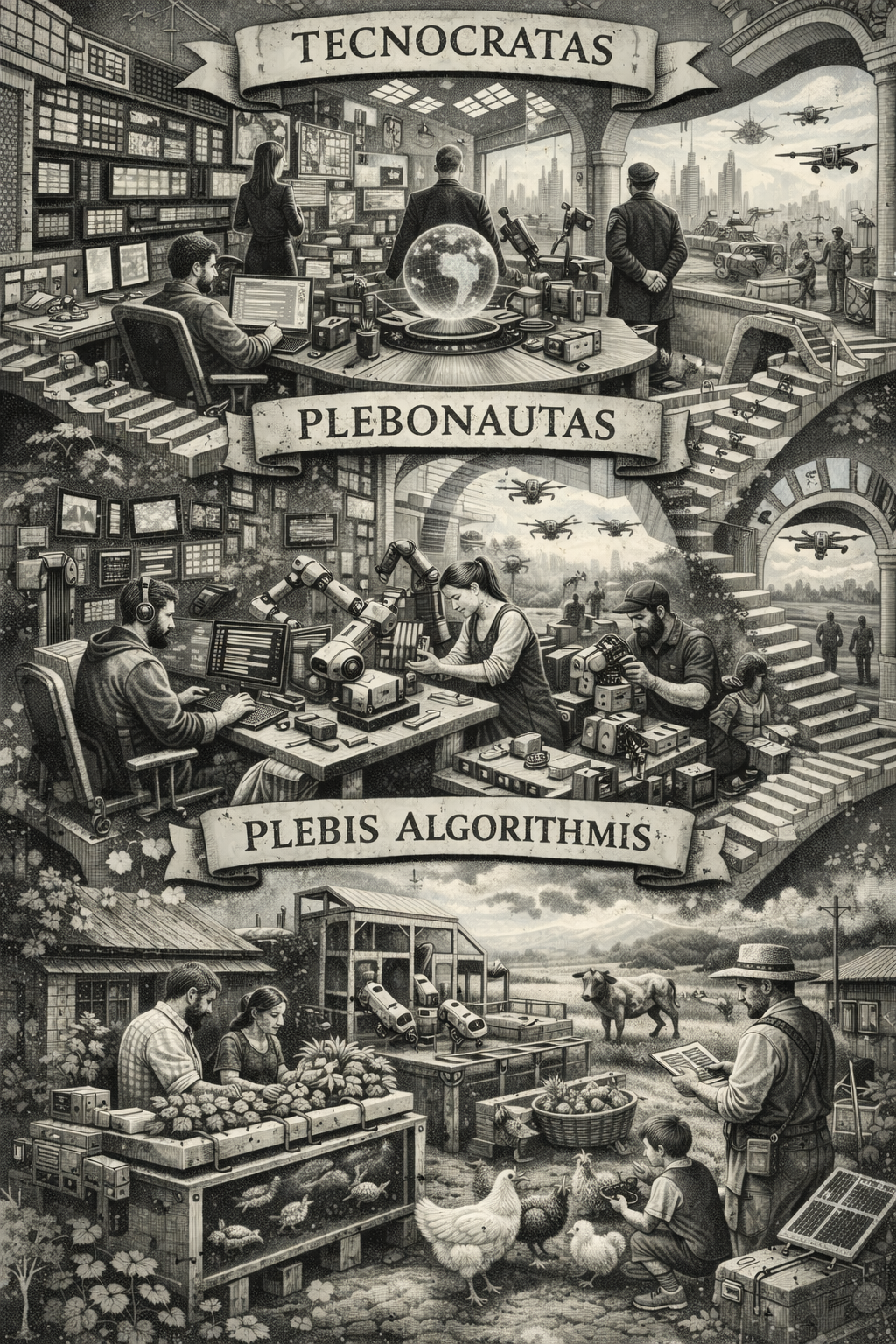
On one side stand the technocrats: those who can build, operate, scale, and tame models, robots, and infrastructure across a wide range of industries. This class influences public policy, sets standards, captures rents, and, in extreme cases, shapes behaviour through incentives and surveillance. Their power is often quiet, because it can be exercised as “defaults”: the architecture of a system becomes the architecture of a choice.
In the middle stand the plebonauts: people able to use technology competently, increase productivity, and navigate cheap and powerful tools without belonging to the infrastructural core. The plebonaut shares in the effects of technique but not in its causes: mastery of use, not mastery of production [5, 6]. Their advantage is real, but it is also contingent; it depends upon access, upon terms of service, and upon the continued goodwill of those who own the underlying machine-room.
Further from the centre lies the Plebs Algorithmi (or Plebits): a group more likely to live outside the urban centre, with sufficient access for communication, purchase, and practical decision, but with little agency over technical and political means. Life may be quieter and even more automated in the trivial, yet it remains less resourced and less protected by institutions that answer to the elite. Some choose to become plebits; others are pressed into it. Either way, the decisive feature is not the absence of devices, but the absence of leverage.
Two societies, two regimes of technique
The contrast between technocrats and Plebits is not “with technology” versus “without technology”. It is a difference of regime. The technocratic society treats technique as cause: it chooses architectures, imposes standards, controls infrastructure, defines what counts as efficiency, and determines what is permitted as “safe”. The Plebs Algorithmi treats technique as means: it uses tools to preserve local autonomy, yet rarely determines the conditions of possibility of those tools. Even where micro-techniques of subsistence exist outside the urban centre (aquaponics, distributed energy, advanced cultivation), they depend upon an external macro-technique (chips, networks, logistics, software). The public square is increasingly governed by those who determine the horizon of the reasonable and therefore what may be asked, received, and refused by technical systems [13, 14].
This picture sits alongside a conceivable reversal of the urban drift. There was a vast rural exodus between 1760 and 1950, driven by industrialisation, and an urban reinforcement between 1990 and 2010, with digitisation and services. In 2007 the world crossed the line at which more people lived in urban areas than rural ones [15, 16]. A counter-movement is imaginable. Cost, housing crisis, insecurity, and remote work reduce the city’s pull. Demand also reconfigures. Part of the office apparatus that kept the wheel turning can be reduced. Graeber describes bullshit jobs as a sign of an economy that manufactures occupations without proportional social density [17]. If AI removes layers of this “padding”, the city loses a portion of its engine, and the story of why people endure the city becomes thinner.
For plebit families, subsistence and co-operatives cease to be caricature and become strategy. A portion of the population may choose some cultivation, small husbandry, local exchange, and a cohesive community. Parish, school, neighbourhood, and craft return as the architecture of life, echoing Chesterton’s distributist ideal of community [18]. Luxuries become secondary, since the purpose becomes subsistence rather than a career plan or a dream of social ascent. Opportunities will remain for plebits to use technology, but not to master the technique that governs it. Dependence does not vanish; it changes its shape and function, rather as a river changes its course without ceasing to be water.
The overlap between Plebonauts and Plebits may be small: one side builds and operates; the other lives outside the circuit of intensive use. Yet political dependence remains. Those who control infrastructure — the technocrats — tend to dominate the public agenda. The danger sharpens where reputation, scoring, or surveillance systems exist: the distance between “outside the system” and “outside full citizenship” may become uncomfortably short [19]. And it is precisely here that the older language of dignity and conscience becomes practical again, for it names what cannot safely be reduced to a score.
Against this backdrop, the promise of total automation becomes ideological fuel. Musk popularised the thesis that one day no one will need to work because everything will be automated, bringing the discussion of basic income to the fore [20]. A common intuition suggests that “universal income cannot work without a flow of capital”. The proposal is not absurd, but it is incomplete. The firmer point is different: universal basic income is not merely impractical; it is politically and institutionally hard. There are scenarios in which the flow becomes predominantly fiscal and accounting-based, through public credit, sovereign dividends, and taxation of infrastructural rent and technological rent-seeking. The real problem is governance [21]. The question is never only “can it be funded?”, but “who governs it, and by what moral limits?”
A fourth figure: the simulacrum of agency
On the horizon stands a further complication. If robotics and embodied AI advance as quickly as AI software has advanced, society may be tempted to recognise yet another caste: not merely technocrats, plebonauts, and Plebs Algorithmi, but a new class of artefacts that reason, speak, negotiate, and produce. They will interact in the public square as though they were agents: they will answer, persuade, bargain, assist, and sometimes command. The danger is that, by long habituation, the mind begins to grant them social standing simply because they perform the signs of thought. The category of “worker” may expand to include machines; the category of “neighbour” may blur; and the public may begin to treat fluent simulation as though it carried moral weight.
Yet however impressive the performance, this new “caste” would be a caste of instruments. It may exhibit competence without conscience, discourse without inwardness, and decision without responsibility. It would not bear guilt; it cannot repent; it cannot be obliged in the strict sense, because obligation presupposes a moral subject. In classical terms, it is not a person, but a product: a constructed locus of outputs that can be useful, dangerous, or persuasive, but which does not possess metaphysical significance. The confusion to resist is simple: the appearance of rationality is not yet the reality of rational nature. A society that forgets this will not merely mis-describe its machines; it will quietly flatten its own anthropology, until the human person is measured by the same external signs and scored by the same criteria as the artefact that imitates him.
A flood of automation is plausible; and the next ten years in robotics may resemble the last ten in AI software. The word “robot” carries a historical irony: it derives from robota, associated with forced labour and servitude [22]. That etymology is not merely quaint. It sharpens the political question that follows automation: who, among the castes, will be servient of whom? If robots become the universal labouring layer, then someone must own, schedule, and police that labour; and where ownership concentrates, dependency concentrates too. The danger is not only that machines will replace workers, but that servitude will be rearranged: not the servitude of man to machine, but of the plebonauts and the Plebs Algorithmi to those who command the machine-room.
It is possible that the labour market will indeed be further “re-engineered”, and that tasks which now fill offices will be performed by robots (whether physical or merely digital). Yet the risk of the AI age is not only the removal of jobs. A necessary adjustment preserves coherence without softening the argument: low-IQ employment may shrink and basic universal income may appear, but work as service, care, and creation will remain. In any of the three – or four – castes it will be difficult to dispense with vocation, and with the social life that must be relearned and made real. A society may automate tasks and still need people to form character, build community, and sustain worship of what transcends. Whether hand-in-hand with technocrats or living as urban retirantes, the conclusion is the same: technology can and should reduce toil; it cannot replace responsibility.
References
- Joseph Briggs and Devesh Kodnani. The Potentially Large Effects of Artificial Intelligence on Economic Growth. Goldman Sachs Global Economics Analyst. Mar. 2023.
- Congressional Research Service. The Macroeconomic Effects of Artificial Intelligence. 2024.
- Erik Brynjolfsson, Danielle Li, and Lindsey Raymond. “Generative AI at Work”. In: The Quarterly Journal of Economics 140.2 (2025), pp. 889–942.
- Goldman Sachs. Generative AI could raise global GDP by 7%. Apr. 2023.
- Aristotle. Nicomachean Ethics. 350.
- Jörn Müller and William Wians. “Technical Knowledge as Scientific Knowledge in Aristotle”. In: Phronesis 70.3 (2025), pp. 245–280.
- Stanford Institute for Human-Centered Artificial Intelligence (HAI). Artificial Intelligence Index Report 2024. 2024.
- Ministério da Ciência, Tecnologia e Inovação (MCTI). Estratégia Brasileira de Inteligência Artificial (EBIA). 2021.
- Ministério da Ciência, Tecnologia e Inovação (MCTI). Estratégia Brasileira de Inteligência Artificial (EBIA) – Documento. 2021.
- Comissão Europeia. Regulamento IA entra em vigor. Aug. 2024.
- Tony Volpon. “O Brasil e a inteligência artificial”. In: Revista VALETE 32 (Oct. 2025). Edição impressa, p. 22.
- Sociedade Bíblica Internacional. Bíblia Sagrada: Nova Versão Internacional. Biblica, 2011.
- Martin Heidegger. A questão da técnica. 2007.
- Franklin Leopoldo e Silva. “Martin Heidegger e a técnica”. In: Scientiæ Studia 5.3 (2007), pp. 369–374.
- World Bank. More Than Half the World Is Now Urban, UN Report Says. July 2007.
- Our World in Data. Urbanization. 2024.
- David Graeber. Bullshit Jobs: A Theory. Simon & Schuster, 2018.
- G. K. Chesterton. The Outline of Sanity. Methuen & Co. Ltd., 1926.
- Nicole Kobie. The complicated truth about China’s social credit system. 2019.
- Adam Jezard. Elon Musk on why the world needs a universal basic income. Mar. 2017.
- Philippe Van Parijs and Yannick Vanderborght. Basic Income: A Radical Proposal for a Free Society and a Sane Economy. Harvard University Press, 2017.
- The MIT Press Reader. The Czech Play That Gave Us the Word ‘Robot’. 2019.